



Platelet-Rich Plasma (PRP) therapy has developed in recent years into one of the most promising treatment methods in aesthetic and regenerative medicine. This innovative autologous blood therapy utilizes the body's natural healing powers and offers a gentle alternative to more invasive procedures.
What is PRP and how does it work?
PRP stands for "Platelet-Rich Plasma". It is a concentration of blood platelets (thrombocytes) from one's own blood, which is significantly higher than in the normal bloodstream.
The Scientific Background
Platelets are much more than just clotting factors. They contain over 300 bioactive proteins, including important growth factors such as:
PDGF (Platelet-derived Growth Factor): Promotes cell growth and tissue repair
TGF-β (Transforming Growth Factor): Stimulates collagen production
VEGF (Vascular Endothelial Growth Factor): Supports the formation of new blood vessels
EGF (Epidermal Growth Factor): Accelerates skin cell regeneration
These growth factors are normally released during injuries to activate the healing process. In PRP therapy, we specifically utilize this natural mechanism for regenerative and aesthetic purposes.
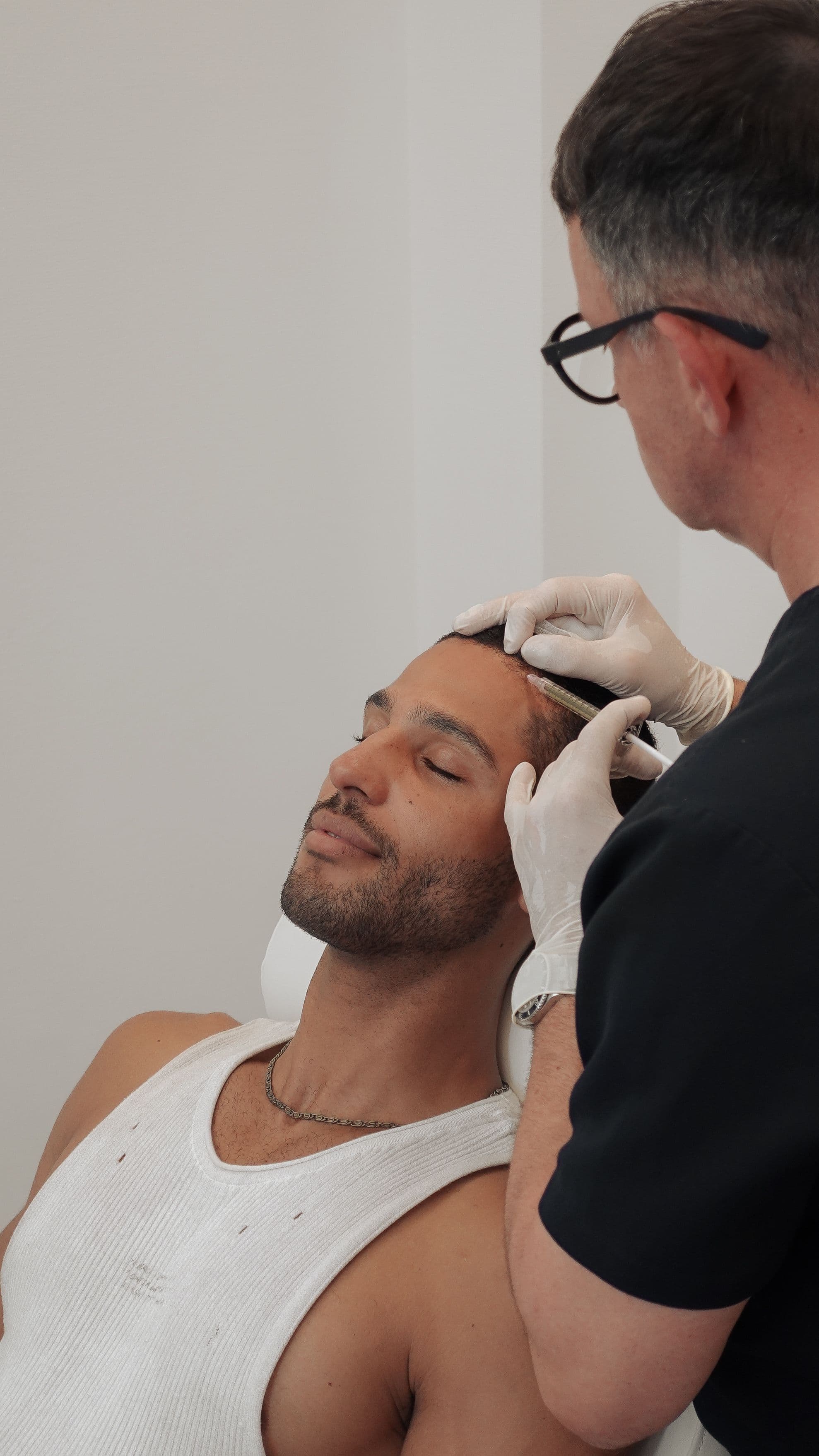
A man in a treatment chair. The treating doctor injects PRP into his scalp.
The Treatment Process
PRP treatment is carried out in several standardized steps:
Blood collection: Approximately 10-20ml of blood is drawn from a vein in the arm
Centrifugation: The blood is separated in a special centrifuge
Platelet concentration: The platelet-rich plasma is isolated
Activation: The platelets are activated to release growth factors
Application: The PRP is injected or applied depending on the treatment area
The entire process takes about 30-45 minutes and is performed under sterile conditions.
Treatment Frequency
For optimal results, 3-4 sessions are required at intervals of 4-6 weeks, followed by refreshers every 3-6 months. PRP can be used preventively at the first signs of skin aging or hair loss. In hair transplants, it improves healing and the survival rate of transplanted hairs.
Skin Rejuvenation from Within
Mechanism of Action on the Skin
The skin particularly benefits from the regenerative effect of PRP. The growth factors stimulate various cellular processes:
Collagen synthesis: New collagen fibers improve skin firmness and elasticity
Angiogenesis: Formation of new blood vessels improves nutrient supply
Cell renewal: Accelerated skin cell regeneration for a fresher complexion
Hyaluronic acid production: Natural moisture regulation is stimulated
Areas of Application in Skin Treatment
Facial Rejuvenation (Vampire Facial) The PRP is introduced into the facial skin using fine microinjections or after microneedling. The treatment is particularly effective for:
Fine lines and first wrinkles
Uneven skin texture and enlarged pores
Dull, tired skin
Acne scars and other superficial scars
Neck Treatment The often-neglected neck area also shows significant improvements with PRP therapy. The delicate neck skin is tightened and smoothed.
Décolletage Treatment Sun damage and age-related changes in the décolletage area respond well to PRP. Skin quality is noticeably improved, and pigment spots can be reduced.
Hand Rejuvenation The hands, which are exposed to environmental influences daily, benefit from the regenerative effect of PRP. Age spots are reduced, and skin texture is refined.
Treatment Course and Results
For optimal results, 3-4 treatments at intervals of 4-6 weeks are usually recommended. First improvements are often visible after just 2-3 weeks:
Increased skin moisture and improved complexion
Reduction of fine lines
Firmer, more elastic skin
Refined pores and smoother skin texture
Results continue to develop over 3-6 months, as collagen regeneration is a lengthy process.
Hope for Hair Loss
How PRP Influences Hair Growth
Hair follicles are particularly receptive to the growth factors in PRP. These have multiple effects on the hair cycle:
Extension of the anagen phase: The active growth phase of hair is prolonged
Strengthening of hair follicles: Miniaturized follicles can be reactivated
Improved blood circulation: Better nutrient supply to hair roots
Stem cell activation: Dormant hair follicle stem cells are stimulated
Indications for PRP Hair Treatment
Androgenetic Alopecia (hereditary hair loss) In men and women with genetically determined hair loss, PRP shows particularly good results in the early stages. The treatment can slow down and partially reverse hair loss.
Diffuse Hair Loss In hormonally or stress-related diffuse hair loss, PRP can significantly improve hair thickness and density.
Alopecia areata (patchy hair loss) In combination with other therapies, PRP shows promising results for patchy hair loss.
Postoperative Hair Transplantation PRP accelerates healing after hair transplants and improves the survival of transplanted hairs.
Treatment Protocol and Expectations
PRP hair treatment is performed through direct injections into the scalp in the affected areas. A typical treatment regimen includes:
Initial phase: 3-4 treatments every 4 weeks
Maintenance phase: Every 3-6 months depending on individual response
First results usually appear after 8-12 weeks:
Reduced hair loss
Stronger, thicker hair
Improved hair density
Healthier scalp
Advantages of PRP Therapy
Naturalness and Biocompatibility
Since only the body's own material is used, allergic reactions are practically ruled out. The body recognizes PRP as its own tissue.
Minimal Side Effects
The most common side effects are limited to:
Slight swelling at the injection site
Minimal bruising
Temporary redness
Combination Possibilities
PRP can be excellently combined with other treatments:
Microneedling for enhanced skin penetration
Hyaluronic acid fillers for additional volume
Laser or radiofrequency treatments
Medicinal hair loss therapies
Who is suitable for PRP?
Ideal candidates:
Patients with realistic expectations
Early to moderate stages of skin aging or hair loss
Individuals who prefer natural treatment methods
Patients without severe underlying diseases
Contraindications
Certain conditions exclude PRP treatment:
Severe blood clotting disorders
Active cancer
Severe infections
Pregnancy and breastfeeding
Certain autoimmune diseases
Conclusion
PRP therapy represents a promising, natural treatment option in aesthetic medicine. By utilizing the body's own regeneration mechanisms, it offers a gentle alternative to more invasive procedures. In both skin treatment and hair loss, PRP shows convincing results, especially when treatment is started in early stages.
The combination of scientific foundation, minimal side effects, and natural mode of action makes PRP an attractive option for patients who desire regenerative treatment without foreign substances. However, thorough consultation and individualized treatment planning are essential for optimal results.